
Winter Access, Snow and Wildfire: Owning a Home Near Buena Vista
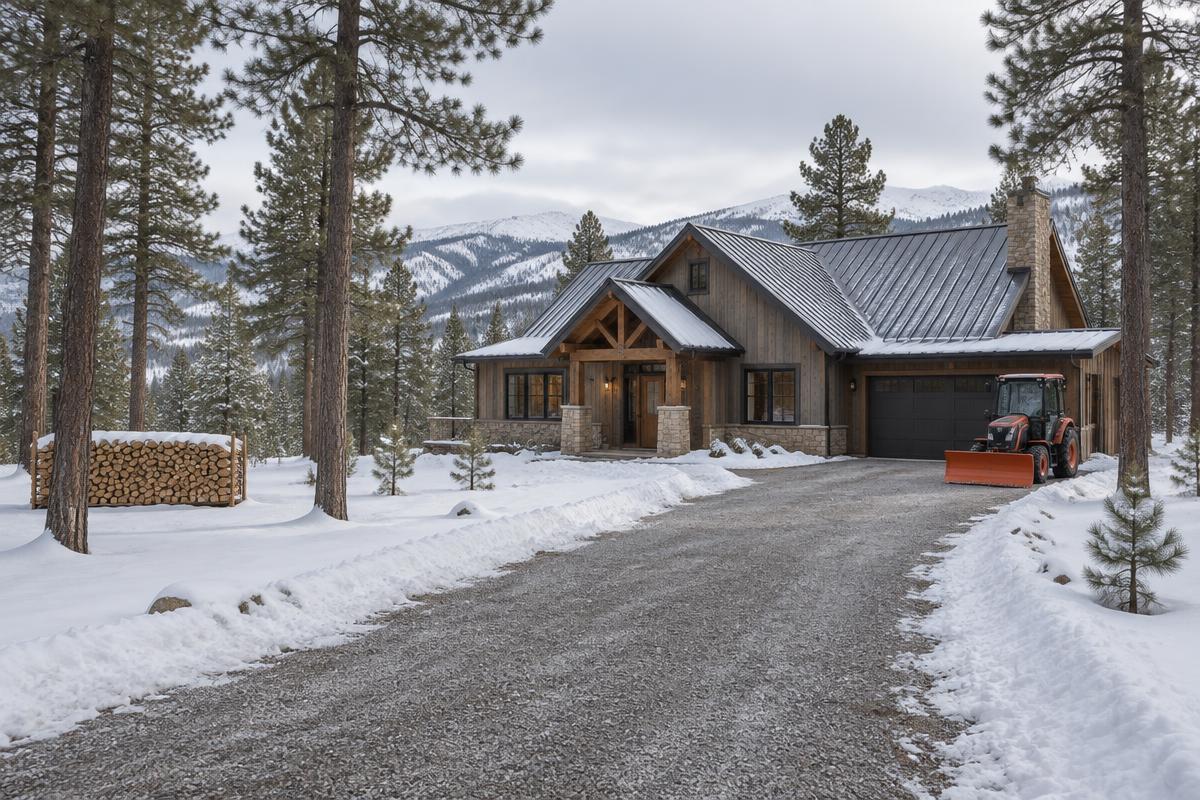
What a Colorado mountain winter and fire season actually cost and require — who plows what, private-road agreements, defensible space, mitigation help and insurance.
How much snow to plan for
The valley and the high country are two different climates. NOAA's 1991–2020 normals put Buena Vista, at about 7,954 feet, near 49 inches of snow a year, with a January normal high and low around 41°F and 11°F. Salida, lower at about 7,160 feet, runs roughly 37 to 48 inches depending on the station and period. Leadville, at about 9,932 feet, sees about 157 inches.
That spread is the whole story when you're choosing a property. A lot a few hundred feet higher, on a north-facing slope, or in a wind drift can hold snow and ice long after a sunny valley driveway has dried off. Treat town averages as a starting point, not a promise about your driveway.
The daily pattern matters too: a sunny 50°F afternoon followed by a hard overnight freeze is normal, and that freeze is what turns a wet driveway into a sheet of black ice at dusk.
Who plows what — and who doesn't
State highways, including US-285, are maintained by CDOT, not the county. Chaffee County Road & Bridge maintains roughly 300 miles of county roads, and it explicitly excludes state highways, town streets and private roads from its winter responsibility.
The part buyers get wrong: the county clears the road, not your driveway. Residents maintain their own driveways and parking areas, and snow can end up pushed across your driveway entrance even though crews try to avoid blocking it.
County service also varies by road and priority, based on traffic volume and seasonal use — some roads get limited or summer-only maintenance. The county says plainly that clearing every road immediately isn't possible, and operations can pause in whiteout or blizzard conditions. If a storm closes the road to your door, it may stay closed for a while.
Chaffee County Road & Bridge: 719-239-4581, office at 10360 County Road 120, Salida.
Buying on a private or subdivision road: ask for the paperwork
This is where access disputes and surprise assessments come from. Before you buy, request and actually read: the recorded access easements and the road maintenance agreement, including who is obligated to maintain the road and whether that obligation runs with the land.
Also ask for any road association or HOA documents, the annual assessment, the budget and reserves, and recent maintenance and plowing bills. Find out who owns or hires the plow contractor, what the contract covers, the trigger depth, service timing and backup arrangements.
Then ask the hard questions: is the road passable for an ambulance or a fire engine, is there a turnaround, and do any bridges or culverts have load limits? What happens if an owner stops paying, or if the association fails to maintain access? Those are property-specific legal questions, so get local advice on the governing documents rather than assuming the worst-case is rare.
Driving it: tires, chains and the traction law
CDOT recommends all-wheel or four-wheel drive for mountain driving when possible, and can activate a passenger-vehicle traction law or chain law on any state highway when conditions warrant. Under a traction law, a passenger vehicle needs compliant tires — at least 3/16-inch tread and qualifying winter, all-weather or M+S tires — or chains or an approved alternative device. Under a chain law, every vehicle needs chains.
The useful mental model: four-wheel drive helps you start and climb. It does nothing for stopping or turning. Tires, speed and following distance decide whether you make the corner, and a private road or trailhead access road after a storm can be far worse than the highway you drove in on.
Check CDOT's COtrip for closures and active restrictions before you leave, especially if you're heading up to a mountain property after a storm.
What snow removal costs
Nobody publishes a Chaffee County price list, so budget from estimates and then get written quotes. A statewide cost source reports roughly $37 to $46 per visit for a typical driveway and sidewalk, averaging about $41, and another estimate for the Salida area cites roughly $30 to $45 per storm, within a much wider $35 to $400 service range.
For a long, steep or gravel driveway those numbers will not hold. Ask contractors to price per visit or per storm, the accumulation threshold that triggers a visit, repeat visits, any seasonal minimum, surcharges for steep or gravel access, ice treatment, clearing the turnaround, and what storm-response priority you get.
Buying your own equipment is the other route, and its cost swings enormously with size and condition — get current dealer quotes rather than working from a budget figure you found online.
Freeze risk and winterizing
Insulate exposed pipes, seal cold-air leaks, keep the heat on during absences, open cabinet doors where plumbing sits on exterior walls, and make sure everyone knows where the main shutoff is. For a long vacancy, ask a qualified plumber whether shutting off and draining the system suits that particular home's plumbing and heating layout.
For a second home or a rental, arrange periodic in-person checks in cold weather to confirm the heat is running, nothing is freezing, snow isn't blocking access, and there's a plan if the furnace or power fails. A thermostat alert is a useful alarm, not a substitute for a person who can drive over and fix it.
Never leave an active wood fire unattended to protect a vacant house. Have heating equipment serviced, run it in its normal safe mode, and put a responsible person in charge of checking on the place.
Wildfire: who's responsible and what's happened
Chaffee County Fire Protection District covers a large area including Buena Vista and Poncha Springs — the town's fire services have been provided by the district since May 2021. Salida Fire Department serves the city, and the two run mutual-aid agreements. Confirm which district serves a specific address before you rely on it.
This is wildfire country. The district's own history includes the 2016 Hayden Pass Fire, the 2018 Weston Pass Fire, the 2019 Decker Fire, and the 2025 Mountain View Fire north of Buena Vista. The county's community wildfire plan points to dry conditions, wind and dead or dying trees as the local concerns.
Burn restrictions change with conditions and jurisdiction, and county rules differ from federal Forest Service and BLM restrictions. Check the county's live status page immediately before any outdoor fire.
Defensible space: what actually moves the needle
Colorado State Forest Service guidance is to start at the house and work outward, because a home's ignitability matters more than the forest behind it. That means a Class A-rated roof; clearing needles and leaves from roofs, decks and gutters; and screening attic, roof, eave and foundation vents with 1/8-inch metal mesh — embers, not flames, are what kill most homes.
Then the grounds: remove branches over the roof and chimney, thin trees and reduce ladder fuels with site-specific forestry advice, clear dry needles and flammable debris right at the foundation, keep grass short, keep firewood well away from the house, and screen under decks and foundations where appropriate. Keep your address visible and make sure responders can actually reach the structure.
Mitigation is maintenance, not a one-time cleanup. A mitigation plan is a property-specific assessment, usually with a forester, that tells you what to thin, how to dispose of it and which home-hardening work matters most.
Help that's actually available
Chaffee Treats offers a free forester consultation and forest-management plan to eligible owners inside its Treatment Priority Areas — confirm current eligibility and funding before you count on it.
Chaffee Chips runs free chipping events for participating landowners in scheduled service areas, with piles set out at the curb on announced dates. It's seasonal and by area, not a standing countywide entitlement.
Chaffee County Fire Protection District's mitigation program supports community chipping and makes mitigation trailers available to residents, subject to availability and booking conditions. All three are worth asking about before you start cutting.
Insurance in a fire state
Getting and keeping coverage is now a real part of owning here. Colorado's property insurance market has been squeezed by wildfire and hail exposure and rebuilding costs, and eligibility comes down to the exact address.
Colorado's FAIR Plan launched in 2025 as an insurer of last resort for owners who can't get traditional coverage. It's limited coverage, not a substitute for shopping the standard market. Surplus-lines placement through a licensed broker is another route when the admitted market says no, but the terms and consumer protections differ.
Insurers will ask about roof age and material, distance to a fire station and water supply, defensible space and other risk characteristics. The district publishes fire-station distance, hydrant and ISO classification information, though carriers use their own underwriting tools. State guidance requires insurers to tell you about wildfire risk scores and available mitigation discounts — so ask each carrier what work it recognizes and what documentation or inspection it wants before you pay for it.
Don't shop on premium alone. Get address-specific quotes covering dwelling replacement cost, wildfire coverage, deductibles, roof terms, water backup, vacant-home restrictions and loss of use.
What to budget
Driveway plowing: roughly $37–$46 per visit as a statewide estimate; get a written local quote for a long or steep drive.
Mitigation plan: free for qualifying Chaffee Treats participants; otherwise a professional consultation.
Brush chipping: free at scheduled Chaffee Chips events when eligible; district mitigation trailers have their own terms.
Class A roof replacement: no local figure to quote honestly — size, tear-off, slope and structural repairs drive it, so get bids.
Homeowners insurance: no reliable Chaffee-specific premium range exists; quote the exact address.
Winterization or periodic checks: scope varies with plumbing, heating and vacancy — request a written local rate.
Before you buy, walk it in the worst season
If you can, visit a property you're considering in January after a storm, not just in July. Drive the road at dusk, test the driveway, look at the roof age and the vents, and stand in the yard and picture the snow line at the door.
Then get the documents: the road agreement, the plow contract, the mitigation plan, the insurance declarations page and the last two renewal notices. A mountain home is a wonderful thing to own and a costly thing to buy blind.
Local links & further reading
- Chaffee County Road & Bridge — winter maintenance and contact
- CDOT — passenger traction and chain laws
- COtrip — live Colorado road conditions
- Chaffee County Fire Protection District — wildland mitigation
- Chaffee Treats — free forester consultation
- Colorado State Forest Service — home ignition zone checklist
- Colorado FAIR Plan
- Colorado Division of Insurance — FAIR Plan information
- Chaffee County — fire restrictions status
Thinking about a move to Buena Vista?
More guides
- Local Home-Service Contacts in Buena Vista & the Arkansas Valley
- Local Home & Land Lenders in Buena Vista & the Arkansas Valley
- A Local's Guide to the Buena Vista Whitewater Park & River Parks
- Hot Springs Near Buena Vista, Colorado
- Hiking the Collegiate Peaks Near Buena Vista
- Moving to Buena Vista, Colorado: What to Know
- Twin Lakes, Colorado Land & Building Costs: A Buyer's Guide
- Selling Your Colorado Mountain Home: A Seller's Guide
- Buying Land in Chaffee County, Colorado: Loans, Earnest Money and What You'll Need
- Your Step-by-Step Guide to Buying a Home in Buena Vista, Colorado
- Mortgages 101: A Financing Guide for Buena Vista Buyers
- Building with Modulars in the Colorado Mountains: Zook Cabins and SmartPads
- Where to Eat in Buena Vista: A Local's Guide to Restaurants, Coffee and Brews
- Wells, Water Rights and Septic in Chaffee County: A Buyer's Guide
- Short-Term Rentals in Buena Vista, Salida and Chaffee County: Rules, Taxes and Income
- Living in Salida, Colorado: A Local's Guide to the Town
- Living in Leadville, Colorado: A Local's Guide to the Town
- Living in Twin Lakes, Colorado: A Local's Guide to the Village